New Everyday Spirituality Blog
Monday, 6 February 2012
I'm relocating...!
New Everyday Spirituality Blog
Wednesday, 10 August 2011
Riots, looting and the search for an alternative
During the election campaign of 2010 David Cameron was pictured astride a Quattro with the slogan ‘It’s time for change’, with Labour’s comeback replacing the slogan with: ‘Don’t let him take Britain back to the 1980s’. The ad of course mimicked the much loved ‘Life on Mars’ character Gene Hunt, who was always ready to fire up his dream machine and leap into aggressive action.
I doubt even Mr Cameron realised at the time just how close he would end up taking us back to the 1980s. The cuts, strikes, riots and disaffected youth that have erupted since he took his seat at Number 10 have brought us eerily close to the ‘Ghost Town’ immortalised by The Specials in 1981. Yet today as Britain faces another night of potential violence and destruction, and politicians and the police are vociferously insisting (on every news channel, blog or social networking forum they can get access to), that the full force of the law will be used against the perpetrators, I wonder whether there may be a less aggressive, less violent, and more positive way of trying to turn the tide of social disintegration and urban anarchy we appear to be facing.
Former atheist, Shelley Yates experienced communicating with spirit beings when she died before being brought back to life. She now believes we are all spiritual beings capable of creating miracles, and that collectively we have the potential to heal the world, not just destroy it. In 2007 and 2009 she co-ordinated two global meditations, and is planning the third for November 2011. In the first of these ‘Fire the Grid’ meditations millions of people took part in over 80 countries, spending an hour doing something that brought them joy, with the aim of shifting the earth’s vibrations to produce a better future for our children.
A cynic would say this is wishful thinking, and that looking for the joy in everything simply ignores the very real misery and suffering we see around us everyday. This is a fair point, however, there is something to be said for focusing on the positive and joyful things that are going on around us everyday, rather than allowing the negativity to expand and fill every waking moment. It is a core principle in things like mindfulness or cognitive behaviour therapy for instance, which aim at changing the way people think about and react to the world around them. And although this may not always be sufficient to change the world in itself, it can give people the tools and confidence to tackle issues which previously appeared insurmountable.
The problem is we rarely see anything positive portrayed in the media – and if we do it comes as the ‘and finally…’ story at the end of the ‘more important’ news of misery and destruction. What if every single one of Shelley’s millions of people in their 80 countries had been given media time to show people that there are some positive things going on in the world if we just sit up and take notice? Could we retrain the media to see the positive in the world, or is nobody interested?
What has this to do with this week’s looting? Well I was one of the peaceful marchers on 26 March in the London March for the Alternative this year. I spent all day surrounded by millions of other peaceful marchers, supportive police and a genuine sense of being in this together, for each other. Yet in the days that followed all I saw in the newspapers and on television were reports of the tiny minority of protestors who had decided to use violence and force to get their message across and shatter communities as a result. People I spoke to knew only this side of the story, and heard nothing about the genuine sense of togetherness and community spirit that arose for those who had taken the time out to march and make a positive stand.
What if the headlines the following day had been about this instead? – Cameron’s ‘big society’ out on the streets and ready to come together in the hope of making a positive change for our kids. It was an amazing sensation to be a part of that, it felt liberating, empowering and potentially (if rather idealistically!) world-changing. Whilst some may argue it had no real impact and didn’t change the world for the better, many thousands of people who took part in that march have since gone on to stand up for services in their local communities, to volunteer to keep community initiatives running despite the cuts that have closed so many others down, or to lobby their MPs and secure changes - however small - in the cuts being proposed. They continue to believe in an alternative. But our media has chosen to ignore this potential for peaceful change and focus instead on the more headline grabbing violence of the few, reinforcing in the reader’s mind that we are a society out of control on self-interest and mindless violence.
But are we? Shelley Yates and the millions of participants in her global meditations think not, yet where were the headlines when they performed their peaceful demonstrations to heal the world rather than destroy it? It would appear it doesn’t make good news, however many millions are involved. Perhaps it is time for an alternative - not to fire up the Quattro and return to the misery of the Ghost Town, but instead to take a leap of faith and fire up the grid! Whether or not it has any concrete impact in our material world, at least it won’t involve a massive clean-up the following morning, and nobody will get hurt. At the very least, it will ensure everyone thinks about something joyful for an hour instead of all the misery. Surely that can’t be a bad thing.
Tuesday, 26 July 2011
Medium Madness on the BBC?
Broadcaster Rosie Millard had a right bee in her bonnet this weekend, over the question ‘should money making mediums be banned?’ discussed on this week's Sunday Morning Live. She had a double pronged attack: firstly, that charging by these ‘con-artists’ should be banned, and secondly, that if mediums have a ‘gift’ then they shouldn’t charge for it. It should be offered freely. As one of the studio guests pointed out, her reasoning was therefore slightly flawed and contradictory, and the programme failed to open the floor for intelligent debate.Friday, 1 July 2011
Grave stones and kipper ties
At The Open University we pride ourselves on being at the forefront of developments in distance learning. In the early days, this meant late night television programmes with mad scientists wearing kipper ties – the hallmark of what our University stood for. Today it is about high profile prime time television series such as ‘Coast’, but it is also about using the online environment creatively to deliver course materials to students in the best possible ways.As academics at The Open University, we can feel cut off from our student body, and students can find the faceless course materials a little impersonal – never knowing who really produced the things they are studying. One of the ways we can overcome this is to build on the OU’s history of audio-visual expertise, and many of our online courses now have embedded within them carefully crafted video presentations so students can meet the academics behind the scenes, learn about their research, and get a sense of that face-to-face learning they might enjoy at a more conventional university. Of course putting yourself in front of camera requires certain skills and competencies, and the confidence that you can ‘get it right’.
So staff at the OU are offered opportunities to go on intensive ‘media training’, where they can learn how to record a piece to camera. And this is why yesterday afternoon I found myself striding through a graveyard, chucking tarot cards over my shoulder and talking earnestly into the lens of a camera held by a cameraman backing away from me; both of us trying not to trip over fallen gravestones in the process.
When I mentioned to the production team that I was thinking of using tarot cards as a prop they had immediately jumped on the idea of using the graveyard as the location. I found myself feeling a little ambivalent however. I was talking about my research - and my research shows that people’s relationship with spirit, otherworldly entities and the deceased is not all about graveyards and churches. The message from my research is that, for some, the power of spirit is all around in everyday places, and not restricted to stereotypically ‘spooky’ sites or encounters.
Yet there’s no denying that gravestones and churchyards speak symbolically of spirit and otherworlds, and I have to admit that shooting on location next to the church was a lot more appealing than sitting behind a desk in the recording studio. So there I was, pacing slowly forwards through overgrown grass and grave plots, wondering whether I was going to get to the end of my piece-to-camera without falling over, wondering how we might be able to use a similar technique in our new course, and wondering of course if I was 'getting it right'… But I think above all else, I was wondering whether I should have worn a kipper tie for the day.
Tuesday, 25 January 2011
Is there anybody there...?

Colleague: Angel healing? What’s that?
Sara: It’s where the healer channels energy from angels.
Colleague: But angels don’t exist do they, so how can they heal? That’s just ridiculous! [Nervous but self-righteous laughter]
Tuesday, 5 October 2010
Harvest Festivals: What does it all mean?

Wednesday, 12 May 2010
ME Awareness Day: All in the mind?

Yet in my mind, does it matter if something has been scientifically validated if it exists or works in the lives of those it affects? By this I mean - I know I have ME and that it affects my life, regardless of how many scientists or medics might try and dismiss it as 'all in the mind'. As a student of Reiki I also know that when I receive or give myself Reiki healing it energises me and can ease pain. Now I have no idea either what causes my ME, or what it is that is happening when the Reiki relieves me. But I do know that for me, both have very real effects in my life, ragardless of their lack of scientific credibility.
Thursday, 12 November 2009
Psychic Beliefs: do you share yours?
Let me introduce to you my great grandmother - who was a practicing spiritualist medium at a time when she could still have been convicted under the 1735 Witchcraft Act. Police officers would regularly attend her seances undercover, trying to prove she was up to no good. Unfortunately for them, her guides would always draw her attention to the fact that there was 'someone with big feet' in the room who shouldn't be - and she would calmly welcome 'the police officer amongst us' and scare the living daylights out of them!Tuesday, 8 September 2009
Divine guidance? Angels, tooth fairies and what we can 'know'
In a recent posting on the website of The Telegraph Christopher Howse reported on the possible presence of angels amongst us. Suggesting 38 per cent of Britons believe in angels he said ‘a university lecturer’ had criticised parents for dismissing their children’s reports of angel sightings.Howse doesn’t say who that university lecturer is, but his article raises interesting questions and provoked heated comments from readers. These ranged from numerous reported angel sightings by both adults and children, to a fair number of postings expressing a huge degree of animosity, from those who hadn’t seen angels and knew they never would.
What is it that makes people so angry about the possibility of there being things we are yet to fully understand?
And even if angels don’t ‘exist’ (whatever that might mean), for those who believe they exist they have a very real impact on their lives.
One irate commentator said there has never been any tangible evidence of anything like Angels, Father Christmas or God. I’m guessing he would probably include the tooth fairy in that list. Yet thousands of lucky children have tangible evidence of the tooth fairy’s existence. They believe that if they put a tooth under their pillow at night the tooth fair will come and take it and replace it with a coin.
And thousands of children have their theory proved right by the very tangible evidence of a coin the next morning.
Who or what the tooth fairy may be is disputable, but their belief in the existence of a power which can manifest that coin is strong enough to bring that coin into being. The child who knows there is no tooth fairy refuses to put the tooth under their pillow. And hey presto they too have their proof of its non-existence because they don’t receive a coin.
If we believe there are people – or angels – out there who are there to generate good and positive experiences in our world, then chances are we will come across people and opportunities that generate those good experiences.
Whether or not there is ‘tangible evidence’ of the precise origin of that good experience seems somewhat irrelevant to those whose lives have benefited.
Thursday, 23 July 2009
Spiritual spaces?
Monday, 20 April 2009
Magical circles
People have used the circular form in many types of guides for centuries. From stone circles such as Castlerigg and Stonehenge designed to align seasonal changes and agriculture, to manmade circles such as the compass and clock-face which have been key to human exploration of our planet. The circular mandala serves as a spiritual tool and meditative aid. In all its forms the circle represents our human drive to create order out of chaos.
The circle is so common to human life that it easily draws our attention, but is equally easily overlooked. What was it about this circle that inspired admiration, nurture and reverence, rather than the more common response in this day and age of destruction, vandalism or even official removal in the interests of ‘health and safety’ or some equally spurious justification?
Have you come across similar appearances in the landscape?What did you do there and why?What do you think inspires people to make such features and what is it that makes people add to them and admire them rather than disturbing or destroying them?
Tuesday, 17 February 2009
Feature in Soul & Spirit Magazine
Saturday, 31 January 2009
Spiritual triggers
landscapes but in having new eyes’ (Marcel Proust)
I’ve just returned to work after a period of longterm sick leave. Illness often sets us off thinking about questions such as:
What happens if I can’t go back to work?
At the heart of it is a need to connect on some level to something meaningful, which obviously for those bed-ridden and suffering from longterm illness isn’t always easy to do physically.
An ill person is embodied in a semi-functioning physicality. And what this does is to highlight both the importance of the body and its insignificance:
- Important because through illness we suddenly feel let down by our bodies, we realize how much we rely on them functioning efficiently to get us to work, to maintain relationships, to do meaningful things with our spare time.
- Yet insignificant because a really chronic or severe illness can show us just how it is possible to survive and exist meaningfully outside the confines of that body which is letting us down.
So the body might be a site for ‘triggers’ which propel us into a search for meaning beyond our embodied selves. And this is often where a spiritual journey begins. This trigger may be in the form of illness, but it can also come from suffering abuse, a mid-life crisis, or it may even come in less earthly forms such as an encounter with an angel or a spirit guide.
What triggered your spiritual journey…?
Tuesday, 21 October 2008
Divination discrimination?

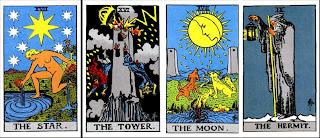
There wasn’t. But in the next question there was, they were all other forms of divination - astrology, numerology, palmistry and tasseography. However, this wasn’t the only link to the world of divination in last night’s programme. On a later question four of the Major Arcana from a deck of Tarot cards featured as players for spot the connection. Although nobody could actually group the four together, one contestant did ask if they might be cards from the Tarot. Victoria Coren confirmed his guess, yes they were all cards from the Tarot, and, she added, they probably all foretell death and doom like all the Tarot cards do.
So what is it precisely that people like Victoria Coren are so fearful of?
Do you use divination?
Friday, 3 October 2008
Me, myself and I..? Or something more important..?
There is a debate in the social sciences I wanted to share with you. Some might say it would be best left where it is. However, I am going to try to give it an airing here because I am interested in your thoughts.
There is much criticism, amongst social scientists, of contemporary forms of spirituality. They see it as nothing more than self-obsessed navel gazing, the product of a society of individuals obsessed with nothing but themselves. For others however this argument is missing the point. For them there is something beneath the veneer of self-obsession which is about a moral ideal we seem to have lost sight of. They would suggest there is a reason people are ‘looking within’ - and that reason is to find the moral compass that guides human actions and notions of what is right and wrong.
Thursday, 10 April 2008
New name for a new age..?
But when I ask anyone to label what it is they are doing for me, they struggle. Some say they are 'workers for spirit', others describe themselves as 'happy generalists' content in exploring whatever works for them.
Ten or twenty years ago, these sorts of practices would most likely have come under the heading of 'New Age'. But nowadays New Age seems to carry a distinct stench of cannabis, caravans and, dare I say it, mothballs (metaphorically speaking, of course). It was something which implied 'leaving behind' much of what contemporary society stood for.
Yet the crystal carriers and meditation practitioners I am talking to today do not tell me they have left behind the trappings of modern life in this way, indeed quite the opposite, they often bring these spiritual tools and experiences right into their everyday lives. I myself carry crystals but remain quite happy in my 1930s semi in suburban England.
So does 'New Age' still serve as a useful label for alternative spiritual practices, or is it time to find a new name?
The New Agers heralded quite literally a New Age, one where we would be spiritually enlightened and at one with the earth; they drew on many traditions including Eastern philosophies, Paganism and Gaia theories. And many New Age camps, communities and individuals continue very much in this vein. But does this adequately describe what the people I am talking to are telling me about?
New Agers were on a crusading counter-cultural drive to change the world for the better. They used techniques, practices and everyday lifestyles which seemed unfamiliar and unusual to mainstream Western capitalist society. Perhaps it is the years of very visible 'New Agers' that now makes it more ‘normal’ to do things which were once considered ‘alternative’, such as meditation, Tai Chi, or crystal healing.
The New Age pioneers were the ones who stressed self-actualisation, recycling, animal rights and green consumerism. And these are now mainstream middle of the road middle-class values... So perhaps what I am exploring has been an unintentional spin-off from the original more purposeful counter-culture.
So what is the new name for this new age..? Answers and comments most welcome...
Monday, 14 January 2008
For God's sake....?
In the UK less than a third believe in God, whilst in the US only one member of Congress has ever admitted being an Atheist. So what is our relationship with God in contemporary society?
What does 'God' mean to you?
Is there 'a' God?
Are there many, or none at all?
What purpose does 'God' fill for you ...if any?
Wednesday, 12 December 2007
Any room for Baby Jesus?
As I sat yesterday morning in the school hall, perched precariously on a tiny plastic chair with my knees in my armpits, eagerly awaiting the arrival of my youngest and her class mates onto the stage set ready for this year's nativity play, I mused on the annual controversythis event in the primary school calender causes.
From informal conversations in the playground, I am fairly sure that the majority of parents in the audience would not be practising Christians. Although I know there were certainly Atheists, practicing Muslims and Pagans in the assembled parent body. Yet nobody voiced concerns that the nativity play was out of place in a school, may be offensive, or in anyway biased towards one interpretation of events (although I'm a little bit dubious that even Christians really believed there were dancing snowflakes and a talking rabbit at the crib-side).
Yet a few weeks ago, some members of the parent body had complained, as Christians, that they did not celebrate Halloween and they therefore re-named the 'Halloween Disco' to the 'Autumn Festivals Disco'. (If they are objecting to the Pagan origins of the festival, perhaps they should look more closely at the origins of some of our other festivals now adopted by mainstream Christianity).
So - it got me thinking. Whilst adults are busy arguing over which festivals we should be allowed to 'promote' in the classroom, there is less debate going on about how we promote these festivals to young minds. As a non-Christian, I for example, have no objection to 'the Christmas story' as told in the nativity play, as long as it is presented as one version of many. I am more interested in my children having a broad education, and learning to be open minded, tolerant and curious about the world, rather than breeding in them the sort of knee-jerk reaction some people demonstrate to select aspects of their curriculum.
As a non-Christian, I thoroughly enjoyed the dancing snowflakes, the talking stars, the singing camels and the plastic Baby Jesus swung around by a four year old Mary more intent on waving at the audience than producing a convincing portrayal of a woman who may or may not have given birth to the Son of God.
Although in an ideal world I might prefer my kids to be learning about spirituality rather than religion, children do have an innate curiosity about what makes us all different, and what binds us together, and events like Christmas can help. I know that alongside participating in the nativity, my children are also learning about 'Christmas around the world' this term, and if we banned the nativity, surely we'd have to stop that too? And what sort of Christmas story would be left to tell then?
How do you think Christmas should be presented to children in schools?
Is there room for Baby Jesus?
Do we throw the baby out with the bathwater?
Or is there an alternative?
Friday, 23 November 2007
Where do you go...?
When you need big answers to big questions, where do you go? Last night Simon Amstell hosted Never Mind the Buzzcocks with Jermaine Jackson as one of his guests. Jermaine Jackson, a convert from Christianity to Islam, has been quoted as saying Islam gives him the answers Christianity never could. In his characteristic style, Simon Amstell could not resist commenting on this apparent jumping about across religions, and remarked along the lines of -
each to his own, that's no problem
whatever gives you the answers you need.
He personally, he said, gets his from Google.
Although the God of Google was summoned for comic effect, does it say something more profound about the level of question we permit ourselves to ask these days? But if you haven't stopped asking the big questions, where do you get your answers? If you have no specific religious framework to offer you the answers you need to these 'big questions', where do you go?
Within?
Your own spiritual guru?
The Mind-Body-Spirit section of Borders?
Google..?
Friday, 16 November 2007
Spiritual props?
For many centuries various religions have provided organisational structures to help followers understand and practice their spirituality - from churches and pews, to rules for everything from patterns of prayer to dress and diet.
But what if you do not follow a particular religion or are trying to develop a spiritual path that makes sense to you? Do you still need these orders and structures and 'ways of doing'?
And if so, what orders and structures do you use?
In the words of one of our bloggers:
How do you find your way?