Tuesday, 21 October 2008

Divination discrimination?


My husband and I enjoyed one of those Jungian moments of synchronicity last night. As one of the first clues came up on Only Connect (the BBC’s answer to mindless quiz shows for people with a knowledge of the Greek alphabet), he turned to me and said ‘Is there some kind of Tarot connection?’

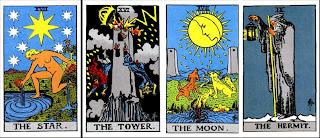
There wasn’t. But in the next question there was, they were all other forms of divination - astrology, numerology, palmistry and tasseography. However, this wasn’t the only link to the world of divination in last night’s programme. On a later question four of the Major Arcana from a deck of Tarot cards featured as players for spot the connection. Although nobody could actually group the four together, one contestant did ask if they might be cards from the Tarot. Victoria Coren confirmed his guess, yes they were all cards from the Tarot, and, she added, they probably all foretell death and doom like all the Tarot cards do.

Those who use the Tarot as a tool for divination or simply to explore their link to a wider spiritual story will tell you however, that even the Death card rarely actually refers to death. So why does Tarot still have this outdated image of evil, darkness and the occult? There is more death and destruction within the pages of the Bible than your average Tarot deck, and the Bible itself is often used for divination – Bibliomancy.

So what is it precisely that people like Victoria Coren are so fearful of?

Do you use divination?
What form and why?
What reaction do you get from others?

Friday, 3 October 2008

Me, myself and I..? Or something more important..?


‘What we need to understand here is
the moral force behind notions like
self-fulfilment. Once we try to explain
this simply as a kind of egoism, or a
species of moral laxism, a self-indulgence…
we are already off the track’
Charles Taylor (1992) The Ethics of Authenticity

There is a debate in the social sciences I wanted to share with you. Some might say it would be best left where it is. However, I am going to try to give it an airing here because I am interested in your thoughts.

There is much criticism, amongst social scientists, of contemporary forms of spirituality. They see it as nothing more than self-obsessed navel gazing, the product of a society of individuals obsessed with nothing but themselves. For others however this argument is missing the point. For them there is something beneath the veneer of self-obsession which is about a moral ideal we seem to have lost sight of. They would suggest there is a reason people are ‘looking within’ - and that reason is to find the moral compass that guides human actions and notions of what is right and wrong.

Alister Hardy suggested there is an innate spirituality in the human race based on a relational consciousness which has been maintained because it serves us well in terms of survival (this is a spirituality quite divorced from any cultural articulation of this into ‘religion’). So this might also suggest that we have an innate moral drive to connect beyond the immediate state of isolation we find ourselves within by virtual of being individuals. And that ‘self-spirituality’ therefore isn’t an end in itself - i.e. reflecting that we are merely self-obsessed and don’t want to look any further than what we can find within ourselves - but that self-spirituality is in fact a process which leads us back to that innate inner drive to seek out our connection with others.

All around us we see examples of people embarking on ‘personal journeys’ to ‘find the real me’, and the process itself, the ‘journey’, becomes the end in itself, rather than it being a means to an end. Or alternatively it is presented as a process to engage with in order to become a 'better person', a 'better' worker, a 'better' mother, father, lover… there is always room for improvement and always the threat that we just might not be 'good enough'.

Have we have lost sight of the purpose of being in touch with the inner self?

Is it all about the self?

Or is there something more?

Are those who follow a path to inner spirituality solely engaged in that soul-searching for the purpose of getting to know ‘themselves’, or are they engaged in that process in an attempt to get in tune with that innate essence which is in fact shared across all other individuals, and once awakened can serve to reunite and reignite some sense of transcendence or significance beyond that individual self?
I guess basically I am asking – are you in this just for the journey, or is that journey actually going somewhere more significant than yourself..?

Thursday, 10 April 2008

New name for a new age..?

Everyday I come across people who are involved in some kind of spiritual exploration, including those of you who are part of this blog. I hear stories of connecting with spirit through meditation or mediumship, I hear tales of walking with nature, I hear descriptions of crystals carried in pockets and prayers said to angels.

But when I ask anyone to label what it is they are doing for me, they struggle. Some say they are 'workers for spirit', others describe themselves as 'happy generalists' content in exploring whatever works for them.

Ten or twenty years ago, these sorts of practices would most likely have come under the heading of 'New Age'. But nowadays New Age seems to carry a distinct stench of cannabis, caravans and, dare I say it, mothballs (metaphorically speaking, of course). It was something which implied 'leaving behind' much of what contemporary society stood for.

Yet the crystal carriers and meditation practitioners I am talking to today do not tell me they have left behind the trappings of modern life in this way, indeed quite the opposite, they often bring these spiritual tools and experiences right into their everyday lives. I myself carry crystals but remain quite happy in my 1930s semi in suburban England.

So does 'New Age' still serve as a useful label for alternative spiritual practices, or is it time to find a new name?

The New Agers heralded quite literally a New Age, one where we would be spiritually enlightened and at one with the earth; they drew on many traditions including Eastern philosophies, Paganism and Gaia theories. And many New Age camps, communities and individuals continue very much in this vein. But does this adequately describe what the people I am talking to are telling me about?

New Agers were on a crusading counter-cultural drive to change the world for the better. They used techniques, practices and everyday lifestyles which seemed unfamiliar and unusual to mainstream Western capitalist society. Perhaps it is the years of very visible 'New Agers' that now makes it more ‘normal’ to do things which were once considered ‘alternative’, such as meditation, Tai Chi, or crystal healing.

The New Age pioneers were the ones who stressed self-actualisation, recycling, animal rights and green consumerism. And these are now mainstream middle of the road middle-class values... So perhaps what I am exploring has been an unintentional spin-off from the original more purposeful counter-culture.

So what is the new name for this new age..? Answers and comments most welcome...

Monday, 14 January 2008

For God's sake....?

"If there were no God, there would be no Atheists"
GK Chesterton (1874-1936)

In the UK less than a third believe in God, whilst in the US only one member of Congress has ever admitted being an Atheist. So what is our relationship with God in contemporary society?

What does 'God' mean to you?
Is there 'a' God?
Are there many, or none at all?

What purpose does 'God' fill for you ...if any?

Wednesday, 12 December 2007

Any room for Baby Jesus?


As I sat yesterday morning in the school hall, perched precariously on a tiny plastic chair with my knees in my armpits, eagerly awaiting the arrival of my youngest and her class mates onto the stage set ready for this year's nativity play, I mused on the annual controversythis event in the primary school calender causes.

From informal conversations in the playground, I am fairly sure that the majority of parents in the audience would not be practising Christians. Although I know there were certainly Atheists, practicing Muslims and Pagans in the assembled parent body. Yet nobody voiced concerns that the nativity play was out of place in a school, may be offensive, or in anyway biased towards one interpretation of events (although I'm a little bit dubious that even Christians really believed there were dancing snowflakes and a talking rabbit at the crib-side).

Yet a few weeks ago, some members of the parent body had complained, as Christians, that they did not celebrate Halloween and they therefore re-named the 'Halloween Disco' to the 'Autumn Festivals Disco'. (If they are objecting to the Pagan origins of the festival, perhaps they should look more closely at the origins of some of our other festivals now adopted by mainstream Christianity).

So - it got me thinking. Whilst adults are busy arguing over which festivals we should be allowed to 'promote' in the classroom, there is less debate going on about how we promote these festivals to young minds. As a non-Christian, I for example, have no objection to 'the Christmas story' as told in the nativity play, as long as it is presented as one version of many. I am more interested in my children having a broad education, and learning to be open minded, tolerant and curious about the world, rather than breeding in them the sort of knee-jerk reaction some people demonstrate to select aspects of their curriculum.

As a non-Christian, I thoroughly enjoyed the dancing snowflakes, the talking stars, the singing camels and the plastic Baby Jesus swung around by a four year old Mary more intent on waving at the audience than producing a convincing portrayal of a woman who may or may not have given birth to the Son of God.

Although in an ideal world I might prefer my kids to be learning about spirituality rather than religion, children do have an innate curiosity about what makes us all different, and what binds us together, and events like Christmas can help. I know that alongside participating in the nativity, my children are also learning about 'Christmas around the world' this term, and if we banned the nativity, surely we'd have to stop that too? And what sort of Christmas story would be left to tell then?

How do you think Christmas should be presented to children in schools?

Is there room for Baby Jesus?

Do we throw the baby out with the bathwater?

Or is there an alternative?

Friday, 23 November 2007

Where do you go...?

When you need big answers to big questions, where do you go?

Last night Simon Amstell hosted Never Mind the Buzzcocks with Jermaine Jackson as one of his guests. Jermaine Jackson, a convert from Christianity to Islam, has been quoted as saying Islam gives him the answers Christianity never could. In his characteristic style, Simon Amstell could not resist commenting on this apparent jumping about across religions, and remarked along the lines of -

each to his own, that's no problem

whatever gives you the answers you need.

He personally, he said, gets his from Google.

Although the God of Google was summoned for comic effect, does it say something more profound about the level of question we permit ourselves to ask these days? But if you haven't stopped asking the big questions, where do you get your answers? If you have no specific religious framework to offer you the answers you need to these 'big questions', where do you go?

Within?

Your own spiritual guru?

The Mind-Body-Spirit section of Borders?

Google..?

Friday, 16 November 2007

Spiritual props?

Who or what do you need to help make sense of - or to experience - 'the spiritual' in your life?

For many centuries various religions have provided organisational structures to help followers understand and practice their spirituality - from churches and pews, to rules for everything from patterns of prayer to dress and diet.

But what if you do not follow a particular religion or are trying to develop a spiritual path that makes sense to you? Do you still need these orders and structures and 'ways of doing'?

And if so, what orders and structures do you use?

In the words of one of our bloggers:
'spirituality...is a letting go of everything.
And in this state of having let go,
peace, happiness, openness and wonder well up…
Inevitably we bring with us to this state
our own background and experience,
and this influences how we accept the new realization.
Angels, gods, spirits, Wicca,
whatever helps to put it all into context.
Great spiritual thinkers
like the Buddha, Christ, Lao Tsu can help us,
but we must each find our own way.'

How do you find your way?